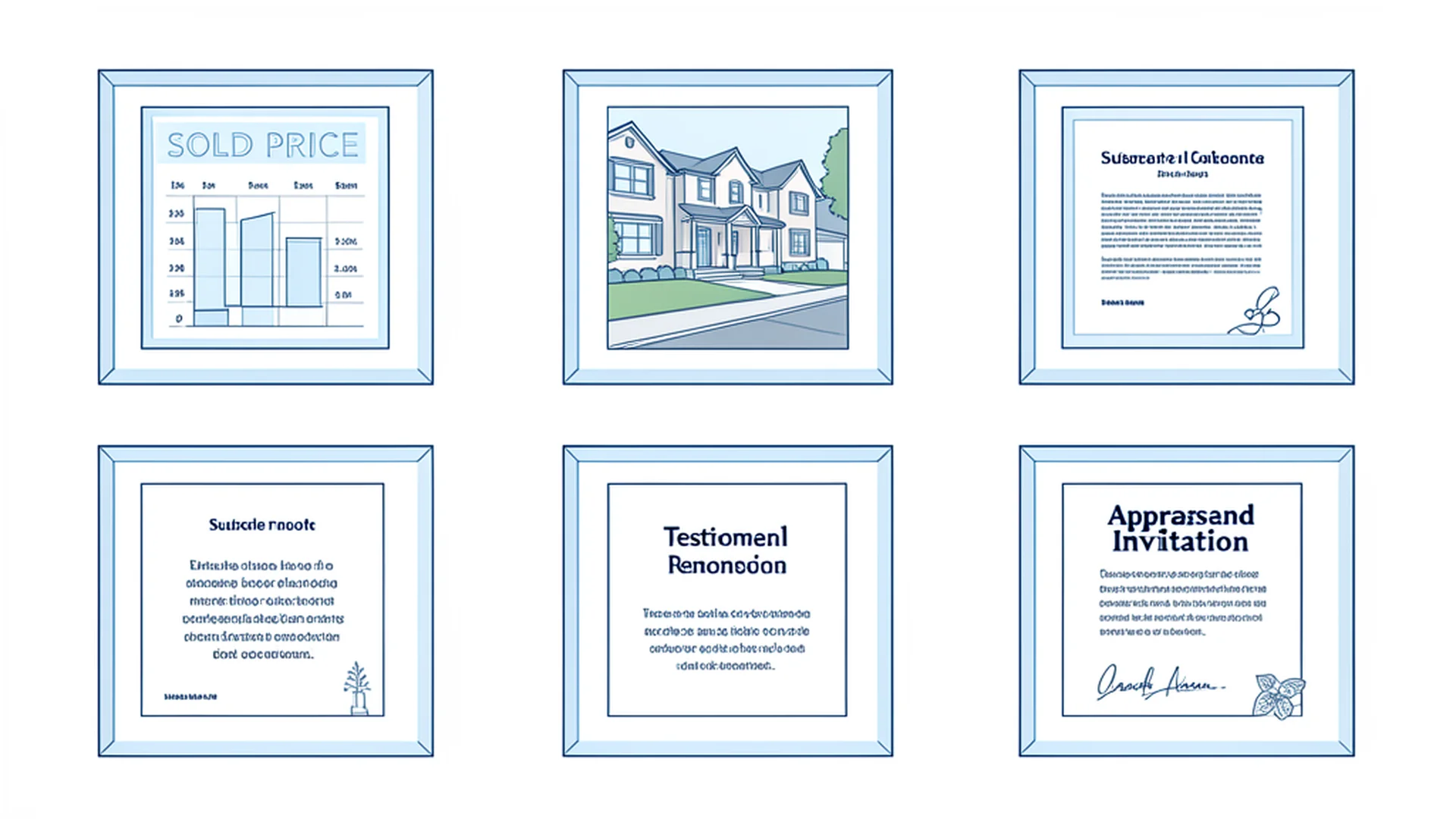
Real estate agents are often told to find a winning ad and scale it. That advice is incomplete. A strong ad can keep running while it performs, but no single concept can address every homeowner, motivation and stage of intent. Meta's Andromeda retrieval system was designed to handle rapid growth in eligible ad creatives — it scans creative signals to predict which user is most likely to respond. If you only give it one concept, you give it one thing to match with.
Five checks before you build your next set of ads.
If three of these checks are weak, your portfolio is probably one concept rendered several times.
Concept families
Do your ads cover at least three of the five concept families?
Good: evidence + problem + proof + responseReal local detail
Does each ad contain specific, verifiable local information?
Good: "Four-bedroom Baldivis homes — recent sales"One argument per ad
Does each ad make a single clear point with supporting proof?
Good: one argument, three sales as proof, one offerFormat serves the message
Is each format chosen for what it does best, not just resized?
Good: Reel for familiarity, carousel for processTest different hypotheses
Is each ad testing a different reason a homeowner might engage?
Good: price evidence vs selling costs vs renovationBuild around the five concept families.
You need ads from at least three families to give Meta meaningful choices. Market evidence attracts curiosity. Seller problems attract consideration. Proof reduces risk. Direct response captures active intent.
Make the ad identify the seller.
Own a four-bedroom home in Baldivis? See what comparable properties actually sold for during the past 90 days.
The first message contains self-selection signals: the person owns a home, it is in Baldivis, it is probably four bedrooms, and the next step is research — not a sales appointment. A homeowner who recognises themselves is more likely to stop.
Choose formats deliberately.
A simple monthly rhythm.
Launch
Publish a balanced set of distinct concepts. Do not launch all appraisal ads at once.
Diagnose
Check lead quality, contact rate and which messages attract each type of enquiry.
Expand
Create a new execution of a proven concept. Do not duplicate the same ad.
Replace
Remove ads with consistently weak engagement or poor lead quality. Document what changed.
Build a creative portfolio, not one hero ad.
You still need the local knowledge — the comparable sales, the buyer patterns, the client stories. Blockwise helps turn those distinct propositions into on-brand creative across Feed, Story and Reel formats, prepare each campaign and lead form, and bring the resulting leads into one review path.
The practical details.
How many ads should I run at the same time?
For a local agent with a modest daily budget, six to twelve genuinely distinct assets is a practical starting point. The key word is distinct — three appraisal ads with different headline wording is one concept rendered three times, not a portfolio.
Do I need professional video production?
No. A short Reel filmed on a phone outside a recognisable local location can be more effective than a polished studio video. The format should serve the message — agent-led video builds familiarity, client video provides proof, and property footage supports a point about the home itself.
Should I show sold prices in the ad?
The ad can show a verified example if you have the right to use it, but it does not need to reveal the full list. The offer should make clear that the requested resource contains the disclosed results. Avoid implying that comparable sales establish a valuation.
How do I know which concept families to start with?
Start with market evidence and direct response. Market evidence attracts curious owners who are not ready for an appraisal. Direct response captures active sellers. Once those two are running, add a seller-problem ad and a proof ad to broaden the portfolio.